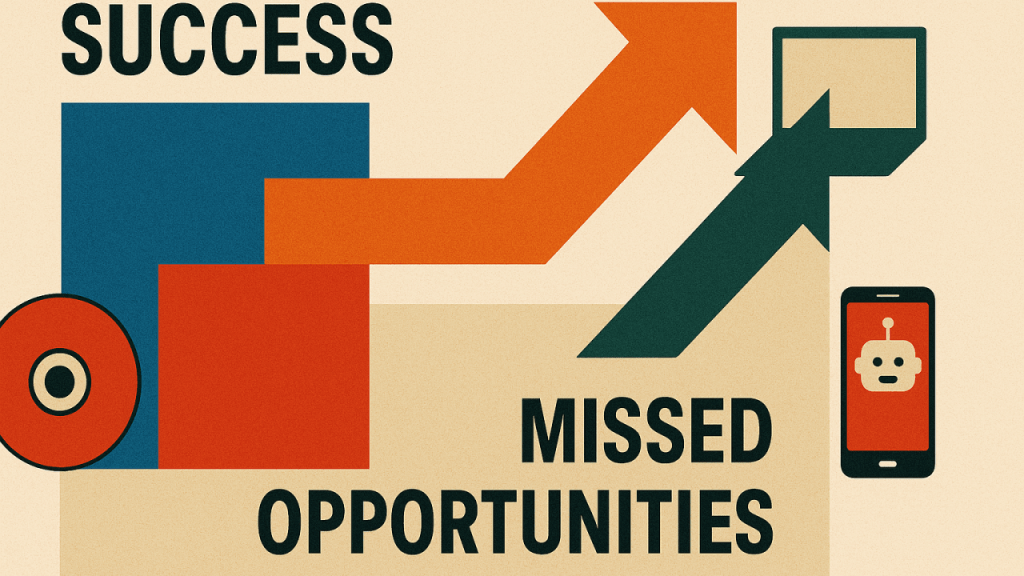
Blockbuster didn’t lack customers. Microsoft didn’t lack talent. But both lacked the pattern recognition to see a shift as it was happening.
Blockbuster was a juggernaut. Its business model rewarded density—shelves packed with DVDs, parking lots full on Friday nights. But when Netflix started mailing DVDs, and eventually streaming them, Blockbuster was too wedded to a revenue model built on late fees and real estate to see it clearly.
Microsoft owned the PC era. But the mobile shift arrived dressed differently. It didn’t look like a smaller computer—it looked like an entirely new behavior set. Apple’s iPhone, and later Android, redefined computing’s center of gravity. Microsoft missed it, and with it, a decade of market leadership.
What these moments reveal isn’t just hubris. It’s a cognitive glitch: success can deafen companies to subtle frequencies of change.
Which brings us to now.
LLMs reached 100 million monthly active users in just 2 months. It took mobile 16 years to reach the same mark.
But this isn’t just another fast-growing channel. LLMs are where intent is forming, not being declared. The moment a person types into an AI assistant, they’re starting a cognitive journey—asking, planning, weighing. They haven’t searched yet. They haven’t committed to action.
And crucially, they are disproportionately:
- Higher-income
- Digitally fluent
- Younger decision-makers
In other words, early adopters that B2B marketers dream of reaching.
Yet many advertisers are waiting for this channel to become more “measurable.” Or they want a map of every place an ad might show up. But that’s not how inflection points work. When you’re early, you don’t get guarantees. You get leverage.
Thrads isn’t a search engine. It’s a layer upstream of search.
It’s a tap into cognitive white space—intent before it’s visible to legacy tools.
And here’s the twist: the most overlooked tool in a B2B startup’s toolkit right now? The advertorial.
Advertorials have long been boxed in as B2C workhorses—supplements, gadgets, and weekend warrior tools. But they’re also one of the rare formats that can quietly slip past hardened filters and invite curiosity instead of resistance. In a world where inboxes overflow and banner blindness reigns, a compelling, editorial-style ad can disarm even the most ad-weary business mind.
Mainstream content sites still carry enormous influence. A well-placed, story-led ad that feels more like a thought process than a sales pitch can reach an exec before their inbox fills with cold outbound and before their LinkedIn DMs are filtered to dust.
Advertorials don’t shout. They nudge. They blend in to break through.
If you believe in edge, not echo—this is your window.
🔮 Try the demo: go.mgid.com/thrads-demo
If you happen to work at a startup or have a B2B offering, feel free to reach out—happy to provide demos without cost or obligation.
MGID can also reach B2B publications programmatically—whether you’re aiming to run branding campaigns or performance-optimized lead gen initiatives, we’ve got you covered. 🌐

 Advertorial Spotlight
Leave a comment